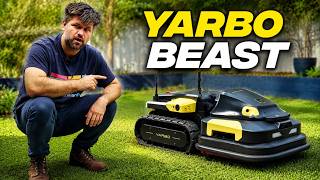
The short version
Key points
- The Luba 3 uses 360-degree LiDAR, Net RTK and dual-camera AI vision on compatible models.
- Its all-wheel-drive system and 80% slope rating are intended for more challenging lawns.
- The larger models use dual high-torque 165-volt motors and offer a 25–70 mm cutting height range.
- The 1,500 model does not include Net RTK hardware, while the 3,000 and 5,000 models do.
- Edges beside fences, walls and raised garden beds may still require a line trimmer.
Cutting performance and all-wheel drive
The larger Luba 3 models use dual high-torque 165-volt motors, adaptive power based on grass density and a claimed cutting efficiency of up to 500 square metres per hour. The cutting height can be adjusted from 25 to 70 millimetres, while the deck is approximately 40 centimetres wide.
In use, the mower produced strong cutting performance and tidy parallel lines, including in thicker grass. Its all-wheel-drive system and official 80% slope rating also make it more suitable for sloped or challenging lawns than a basic robot mower. However, loose gravel, deep holes and waterlogged grass can still cause problems. Powerful turning can also damage weak or freshly laid turf if the mower repeatedly turns in the same location.
App, connectivity and battery
The app provides remote control, scheduling, live yard monitoring, anti-theft tracking and control over mowing zones, patterns, angles and perimeter settings. The range supports Wi-Fi, Bluetooth and 4G. The larger models include built-in 4G with three years of the iNavi service, which can be useful on large properties without Wi-Fi coverage.
The battery capacity starts at up to 15 amp-hours, with charge limits intended to help manage long-term battery health. Off-peak charging is also available. The battery is not designed to be quickly removed and swapped by the user.
The reviewed 3,000 model provides around 175 minutes of runtime per charge, while the 5,000 model is rated at roughly 215 minutes. The mower also includes obstacle avoidance, lift detection, rain detection with an instant stop, IPX6 water resistance and a noise rating of 70 dB or less, according to the supplied information.
Limitations to consider
Edge cutting remains the clearest weakness. The Luba 3 can get closer than many robot mowers, but grass may remain along fences, walls, raised garden beds, tight corners and other boundary areas. A line trimmer is still likely to be needed.
The app offers extensive control, but configuring zones, no-go areas, patterns and schedules can take time. The mower is also expensive and may be excessive for a small, simple lawn.
The review period for this specific mower was only a couple of weeks, so its long-term durability could not yet be assessed. The cutting blades require maintenance and eventual replacement; missed blades of grass behind the mower may indicate that the blades need to be flipped or replaced.
TechManPat’s conclusion
I think the Luba 3 AWD is one of the best options currently available for a large, complicated suburban lawn. I would choose the 3,000 as the sweet spot for most large homes because it includes the full navigation system without moving up to the largest model. The 5,000 makes more sense for a genuinely massive lawn, while the 1,500 remains capable but lacks Net RTK hardware. I would not recommend it for a small, simple lawn, but for multiple zones, slopes, trees and difficult layouts, I believe its navigation and cutting performance justify the price. I would still keep a line trimmer for the edges.
This knowledge-centre summary is based on the linked TechManPat video and reflects the information available when it was published. Check current pricing, availability and policies before acting.